The world’s largest light installation shines on a small Australian town
In 2026, Albany – a port city in Western Australia – will commemorate two centuries since Europeans first arrived on Menang Noongar Country, acknowledging this milestone as part of the area’s ancient and ongoing narrative.
The festivities kicked off with Lighting the Sound, an extraordinary display by internationally renowned Finnish visionary light artist Kari Kola. Marketed as the largest outdoor light installation ever undertaken, it highlighted ancestral, cultural, ecological, and historical themes.
Organised by cultural organisation FORM and produced by Kari Kola, with input from Menang Elders and the Albany community, Lighting the Sound reimagined Albany’s coastline and landmarks with immersive, contemplative lighting across three weekends.
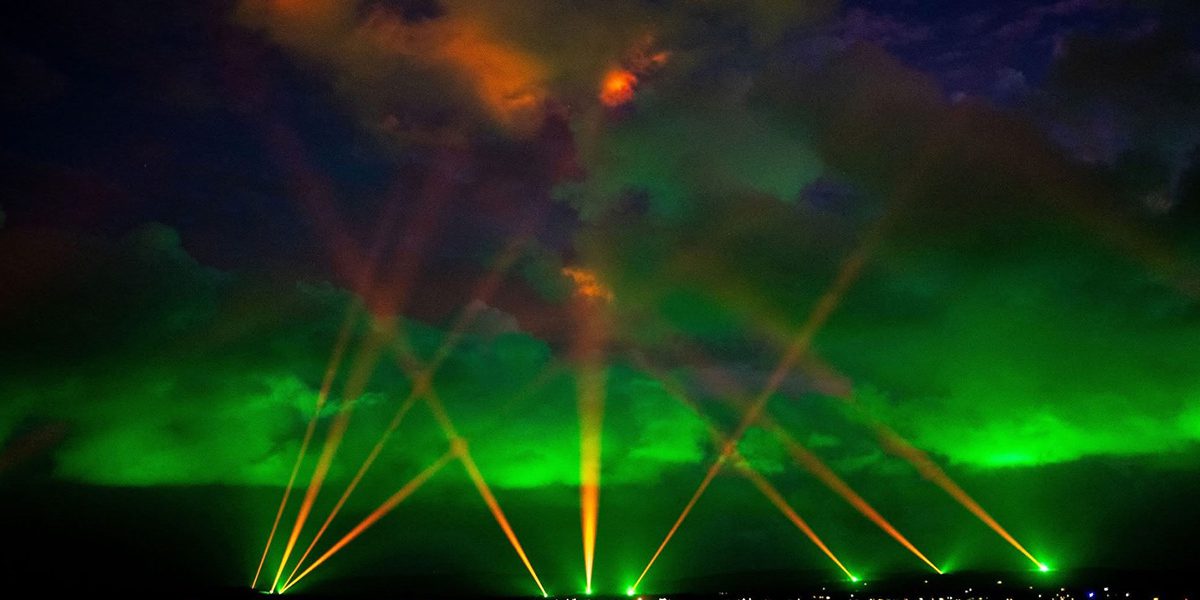
Thousands of hectares around King George Sound glowed, creating a vast tapestry of light. The installation stretched over 15 kilometres and was even visible from space.
Kola is renowned for his work in illuminating both natural landscapes and architectural landmarks, including Ireland’s Connemara Mountains and Stonehenge in the United Kingdom. For Albany, his creative vision was inspired by local history and geography, especially the Bloodroot plant (Menang), the namesake of the region’s First Nations people.
Two years ago, Kola explored the site for the first time and discovered the Bloodroot plant, which later inspired his project. The site’s stunning scenery and reflective water deeply moved him and influenced his design approach.
Achieving his vision took two years of consultation with Menang elders and the Albany community, as well as developing a powerful custom lighting system. Kola originally aimed to light up the hills, but tests showed they appeared too small from a distance. He instead projected beams into the sky, using clouds and weather as elements of the work.
He explained that he seeks both the narrative and the historical context, so that the lighting isn’t just for its own sake but carries significance rooted in the location’s history. The project is conceived specifically for that moment and place, making it impossible to recreate elsewhere. His work uncovers what exists in the landscape, rather than adding anything new.
“It’s a very multi-layered process, so there’s a lot of research at the beginning in terms of why we are creating this, and of course, there’s a lot of research on the technical side also,” he added.
Kola explains that, at the outset of his design journey, he realised no existing lighting equipment could achieve his vision. The display is dominated by green light, with occasional red beams that evoke the appearance of the Bloodroot plant. Producing so much green light was essential to his concept.
He explained, “I realised I needed to design my own fixtures, so I created eleven prototypes using a new type of optics with very precise colour wavelengths.”
Eventually, the team identified the right tools to bring the project to life and went on to produce around 800 LED fixtures. This is a unique technology exclusive to them, with the fixtures manufactured by three different companies, each chosen based on the specific optical requirements; in one case, a particularly long throw was needed.
“They are all wash lights with different opening angles,” explained Kola. “The narrowest one is about 3 degrees, and the widest one is 19 degrees. All manufactured to produce a single colour: green. They are all IP-65 rated. The smaller fixtures are 300 watts and are passively cooled, while the others are bigger, which means it’s a lot of green. This is the strongest green on the planet, I think.”
Working in the natural reserve area, there were many environmental issues to deal with. The team worked with environmental experts for about 1.5 years to realise this, conducting numerous surveys of flora and fauna.
It was soon apparent that towers were the only way forward, with the gear positioned on 20-metre-tall steel scaffolding and generators next to the towers.
“We can do very short cabling, so it’s multiple independent systems basically,” added Kola. “There are thirteen towers, although we were aiming for fifteen, but we had to skip three six months ago due to heavy rain damaging the roads.”
The installation process was surprisingly fast, with the team working around the clock to finish in seven days. Kola then spent five days focusing the lighting.
“I need to carve out what’s important there and work on the details quite a bit,” he said. “And because the weather is changing a lot, it takes time. Realising the scale is something else as the audience is watching the project from 8 kilometres away. From one end to the other, with the car and no traffic, it took 40 minutes to drive.”
The display changes with the weather. Low clouds are reflecting more, there’s more intensity. It’s more condensed. If there’s no wind, there are reflections from the water. If there’s rain, there is much more structure in the air. If there are no clouds, it’s just going higher up, so it’s visible from very long distances.
“The weather and nature are actually creating the dynamics for the project, that’s the idea,” remarked Kola.
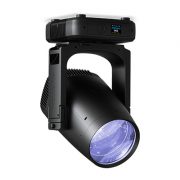
To represent the Bloodroot, Kola required a powerful, narrow beam of light, opting to use Ayrton Mambas equipped with their formidable laser source. These were supplied by Elite Lighting in Perth.
“The Ayrton Mamba is the strongest beam that there is on the market,” began Kola. “They were also ideal due to their weight, as all the gear had to be hoisted one by one to very high positions. They are also equipped with a sun protection system, which was useful in the harsh Australian summer weather.”
Kola states that Mamba was the perfect tool for Lighting the Sound with its very long throw and razor-sharp, narrow beam. Like the rest of the lighting, the beam width remains static throughout the show.
“But it’s full of dynamics still, because it’s a very long throw and it depends on the clouds, it depends on the moisture, it depends on the fog, it depends on the wind, so there are actually lots and lots of dynamics in this,” he commented. “In fact, you cannot capture two identical simultaneous photographs.”
Control-wise, everything is standalone, albeit very precise standalone, with Kola insisting he’s a simple guy who creates simple things, hence no need for complicated control.
“However, the focus took a lot of time,” he points out. “Basically, I don’t need signals on this and signals on this scale, what’s the point? I need to create one image, and that’s it.
“I wanted to create a moment of stillness where people can calm down because I expect that many, many people were expecting something like a show, only that there’s going to be millions of things happening, so what happens if you give them one?”
On the opening night, Kola knew that it worked because he surreptitiously immersed himself in the crowds to see the reaction, and there were lots of people just stopping, taking it in, being present, and almost meditating, and this was exactly the atmosphere that he wanted to create.
This article appeared in the April edition of Lighting & Sound International magazine.